Γλώσσα
 Ελληνικά
Ελληνικά

Διαθέσιμο κατόπιν παραγγελίας


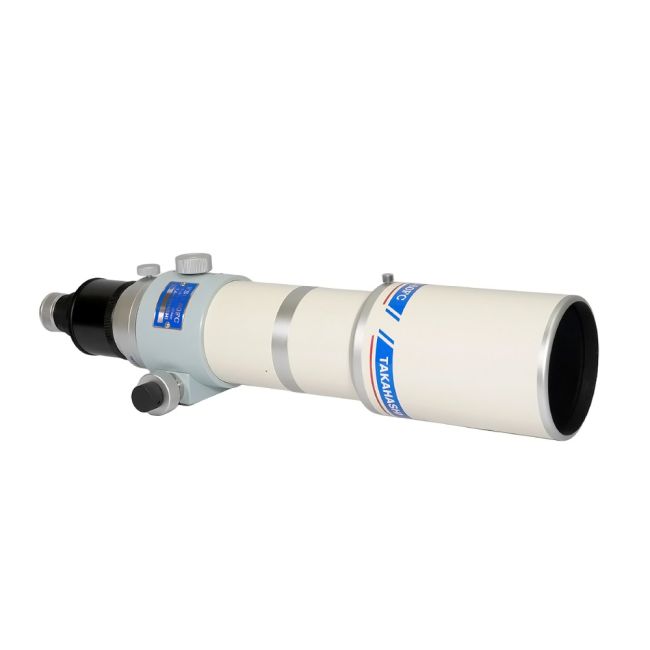
Takahashi FSQ-80FC Quintuplet Double Fluorite Astrograph
A Compact Photo-Visual Telescope Opening a New Era
The FSQ series has long been recognized as the pioneer of flat-field refractors designed for both visual observation and astrophotography. The new FSQ-80FC, a newly designed 5 elements in 5 groups, Double Fluorite Apochromat, continues this tradition while introducing a modernized imaging interface optimized for today’s cooled CMOS cameras.
With its compact body and exceptional optical performance, the FSQ-80FC represents a new generation of high-performance refractors for both observers and photographers.
Optical System
The FSQ-80FC features a 5 elements objective lens in 5 groups. Two fluorite elements are used in the front triplet group to suppress chromatic aberration, while the rear doublet group acts as a field-flattening optical system. This advanced design combines the superb on-axis visual quality of the TOA series with the wide, flat field characteristic of the FSQ series.
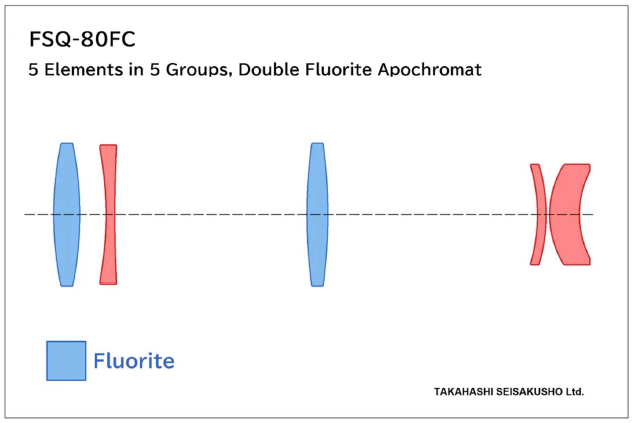
The objective cell has also been newly engineered to securely support the 5-element lens assembly, ensuring both optical precision and long-term mechanical stability.
Following the tradition of its predecessors, the name FSQ stands for Flat-field Supreme Quintuplet.
Exceptional Visual Performance
Although the FSQ-80FC is designed as a high-performance astrograph, it also delivers outstanding visual performance.
Despite its relatively fast F5.6 optical system, the telescope achieves an on-axis visual Strehl ratio of 99.7%, exceeding even the TOA series flagship models in this metric.
Both chromatic aberration and spherical aberration are corrected to an extremely high level, producing an image quality that can effectively be described as aberration-free.
Even at very high magnifications, there is no detectable color fringing caused by the telescope optics, allowing high-contrast observation of bright objects such as the lunar limb and planets. In addition, the optical system maintains excellent correction across the entire field of a 2-inch eyepiece, ensuring sharp and clean views from low to high magnifications.
To support visual use, the telescope provides 159 mm of back focal length from rear end of focuser, allowing infinity focus even when using the optional 50.8 mm diagonal mirror.
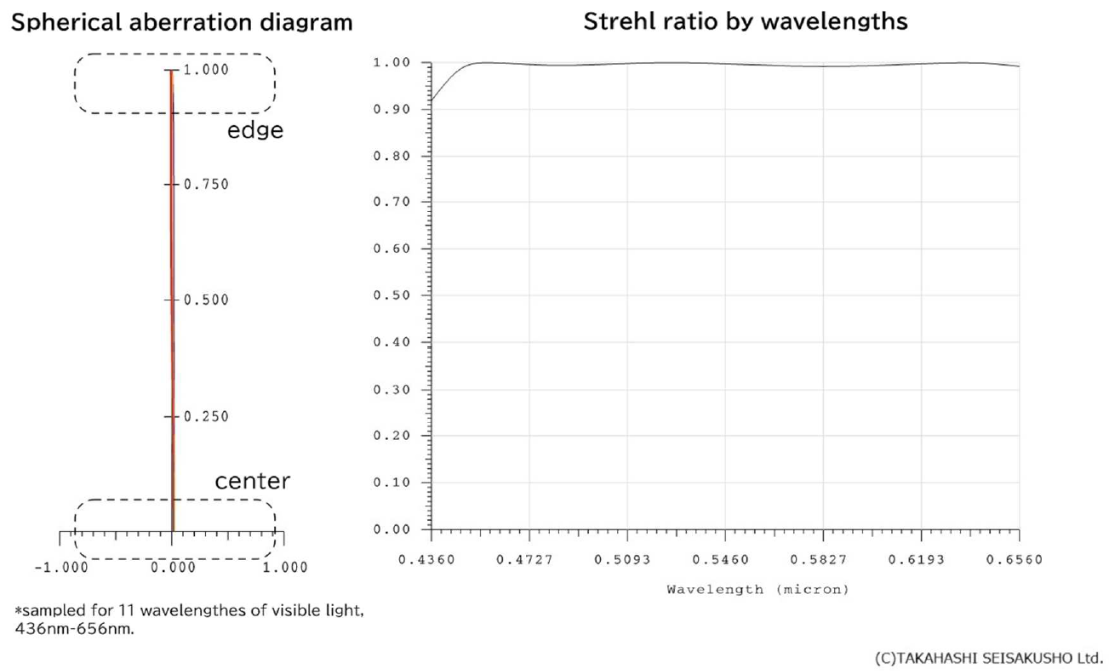
Ultra-Sharp Imaging Performance
The FSQ-80FC has been designed with modern cooled CMOS cameras in mind.
The optical system produces extremely sharp star images capable of fully utilizing the resolution of current and future small-pixel-size sensors.
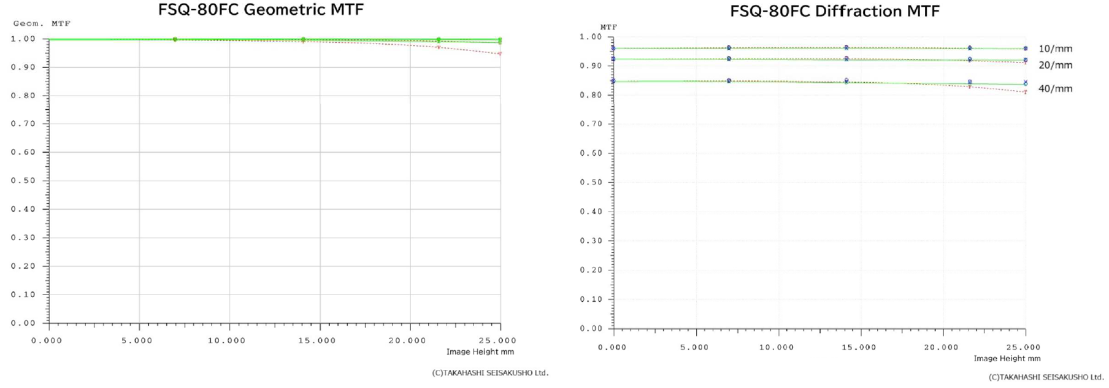
At prime focus, the telescope provides a 50 mm image circle, comfortably covering fullframe sensors. The RMS spot diameter (averaged across 11 wavelengths from 436–656 nm) is 0.8 μm at the center, 2.2 μm at the edge of a full-frame sensor, and 3.0 μm at the edge of the 50 mm image circle.
Illumination across the field is also excellent. 99% at the edge of APS-C, 97% at the edge of full frame, and 93% at the edge of the 50 mm image circle. This ensures that even faint nebula structures near the edge of the field retain their contrast.
Chromatic correction is also extremely high, resulting in virtually no color halo and natural star colors from bright to faint stars.
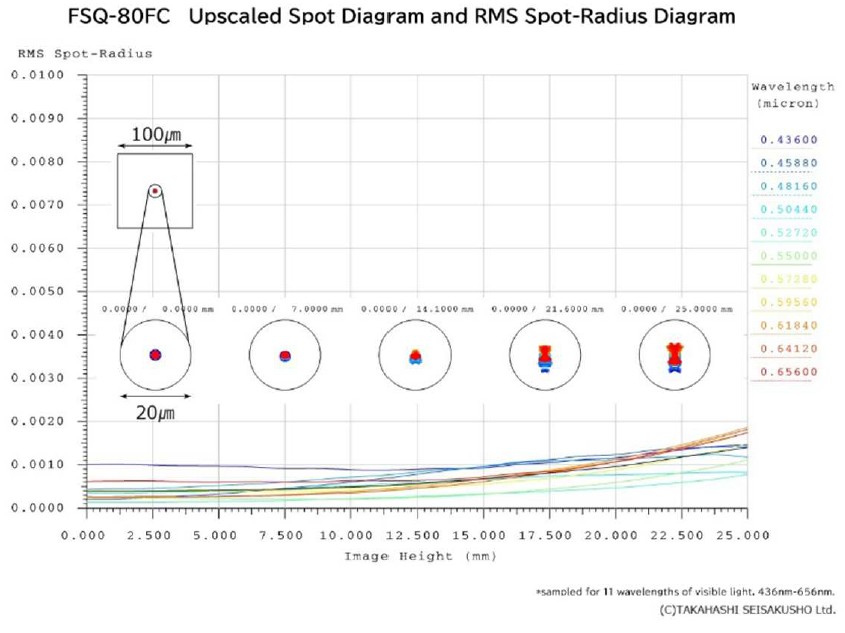
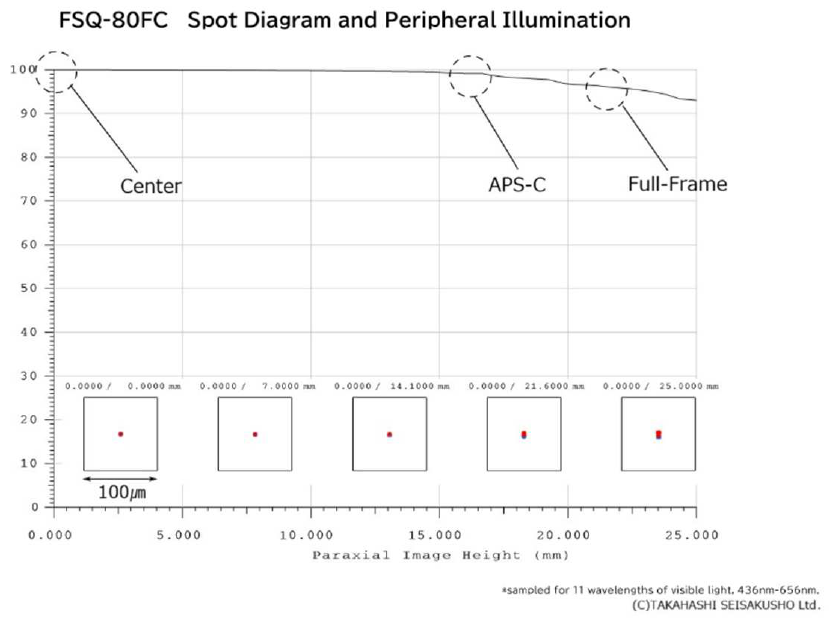
New Adapter System for Modern Cameras
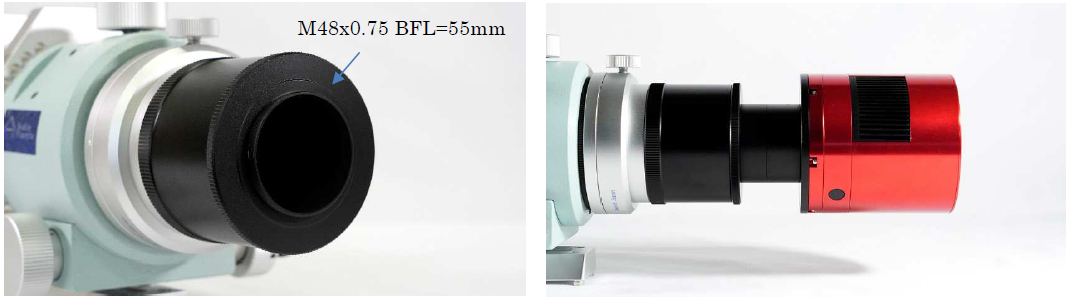
The FSQ-80FC introduces a new adapter ring system designed for modern imaging equipment. By removing the M48 visual adapter, the telescope provides a standard M48 thread with 55 mm back focal length, allowing many cooled CMOS cameras to be attached directly without additional adapters. The adapter also includes an M48 x0.75 internal filter thread.
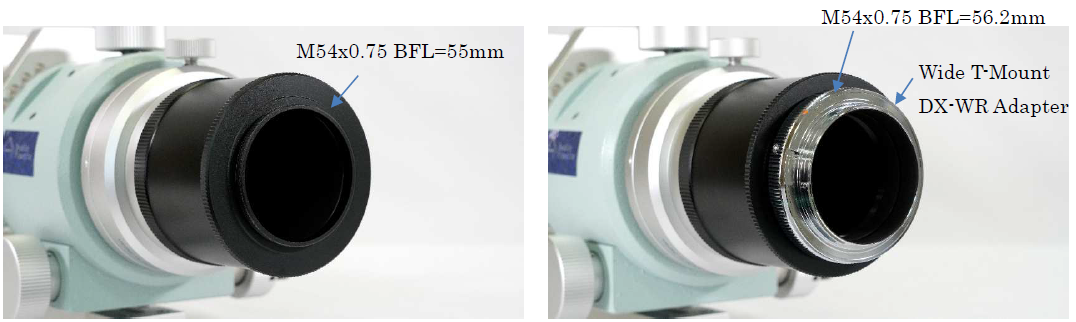
For CMOS cameras with M54 thread and 55 mm back focal length, the optional M72- M54 CMOS Adapter can be used. For Canon-EF and Nikon-F cameras, we also prepare a dedicated adapter.
Precision Focusing
The focuser includes Takahashi’s MEF micro-focus unit with a 1:8 reduction ratio, allowing smooth and precise focusing for both visual observation and astrophotography.
Appendix


| Καθ.Βάρος (γρ.) | 4100 |
|---|

Όλες οι παραγγελίες που δεχόμαστε μέχρι τις 15:00 και αφορούν προϊόντα που βρίσκονται στην αποθήκη μας, διεκπεραιώνονται την ίδια μέρα

Άρτια εκπαιδευμένο επιστημονικό και τεχνικό προσωπικό, είναι στη διάθεσή σας ανά πάσα στιγμή, για να λύσει τις απορίες και τους προβληματισμούς σας σχετικά με τον εξοπλισμό σας.

Σε περίπτωση που δεν μείνετε ικανοποιημένος/η από το προϊόν που παραλάβατε, μπορείτε να το επιστρέψετε εντός 14 ημερών από την ημερομηνία παραλαβής του.

Εμπειρία που εμπιστεύεστε . Το Πλανητάριο ΘΕΣΣΑΛΟΝΙΚΗΣ είναι ο μεγαλύτερος προμηθευτής ειδών αστρονομίας στα Βαλκάνια
 English