Language
 English
English
English
ASTRIAL
The discs for the Star Theatre home planetarium let you travel to many different parts of the universe from the comfort of your own home! - Designed and manufactured in Japan.
In Stock

Ships within 24-48 hours.
Orders received until 3 p.m. are usually shipped the same day.
SEGA TOYS DISC FOR STAR THEATER - COMETS
The discs for the Star Theatre home planetarium let you travel to many different parts of the universe from the comfort of your own home! - Designed and manufactured in Japan.
Comets
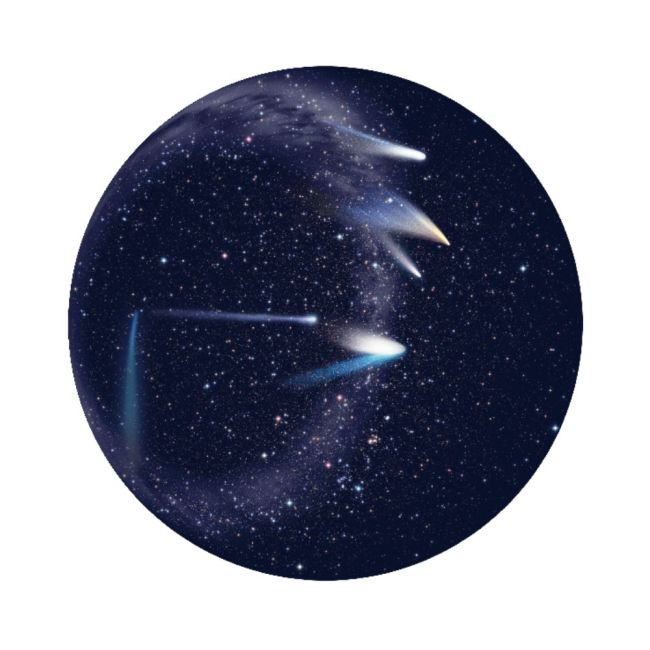
The famous Halley's Comet approaches the sun every 76 years, the next time in the summer of 2061. However, it is not possible to predict when most other comets will come back. The discs shows a review of the of the comets that decorated our sky for a few days between 1965 and 1997. The disc is based on photographs of the comets back at the time they were visible, while reproducing them at their original position. However, the size and brightness have been increased in order to enhance the viewing experience. The photographs used for this discs were provided by Akihiro Fuji.
Comet Ikeya–Seki
The Comet Ikeya–Seki has been discovered almost simultaneously by Japan's famous comet hunter, Kaoru Ikeya, from Shizuoka and Tsutomu Seki from Kochi. After its approach to the sun, it drew a long tail into the sky's east shortly before dawn. The photograph of the comet has been taken on 4 November 1965, when the comet's head as in Corvus.
Comet Bennett
The comet was discovered by John Caister Bennett from South Africa. It became a large comet of magnitude -3, which can be seen with the naked eye. Due to the strong brightness, it even appeared clearly visible in the night sky of the city, decorating the east sky before dawn. The photograph of the comet has been taken on 4 April 1970, when the comet's head was around the front foot of Pegasus.
Comet West
The comet was discovered by Richard M. West of the European Southern Observatory. Because the comet's nucleus split into four fragments, a huge amount of dust was released, creating a beautiful, long tail. The impressive photograph of the comet has been taken on 5 March 1976, when it was rising in the east, shortly before dawn.
Comet Halley
The British astronomer Edmond Halley first determined the comet's periodicity and predicted its approach of the sun approximately every 76 years. Comet Halley's last approach was in March 1986 when the Soviet and the European Space Agency launched spacecraft to investigate the comet's nucleus. The photograph of the comet has been taken on 14 March 1986 by ESA's Giotto spacecraft.
Comet Hyakutake
The Japanese amateur astronomer Yuji Hyakutake from Kohjima prefecture discovered Comet Hyakutake. The comet approached the sun closer than any other planet in the last 200 years. The photograph was taken on 26 March 1996 when it crossed the Big Dipper in the direction towards Virgo approaching the North Star.
Comet Hale–Bopp
Alan Hale and Thomas Bopp separately discovered Comet Hale–Bopp before it became visible to the naked eye. The comet was the most widely observed of the twentieth century as it was one of the brightest for decades. The blue gas tail and the yellow dust tail formed a V-shape. The photograph was taken on 1 April 1997.

All orders we receive until 15:00 concerning products in our warehouse, processed on the same day

Well-trained scientific and technical personnel are available to you at any time, to solve the questions and concerns about your equipment.

If you are not satisfied with the product you received, you can return it within 14 days of receipt.

Experience you can trust. Planetarium of Thessaloniki is the largest supplier of astronomy goods in the Balkans
 Ελληνικά